
Industrial Engineering · Manufacturing Excellence · Operational Improvement
TQM, TPM, Lean, JIT and 5S: How Manufacturing Systems Work Together
Manufacturing excellence is not achieved through one isolated methodology.
Sustainable performance comes from combining quality management, equipment
reliability, material flow, workplace discipline, engineering optimization
and value improvement into one connected operating system.
JIT, Lean Manufacturing, Preventive Maintenance, Industrial Engineering,
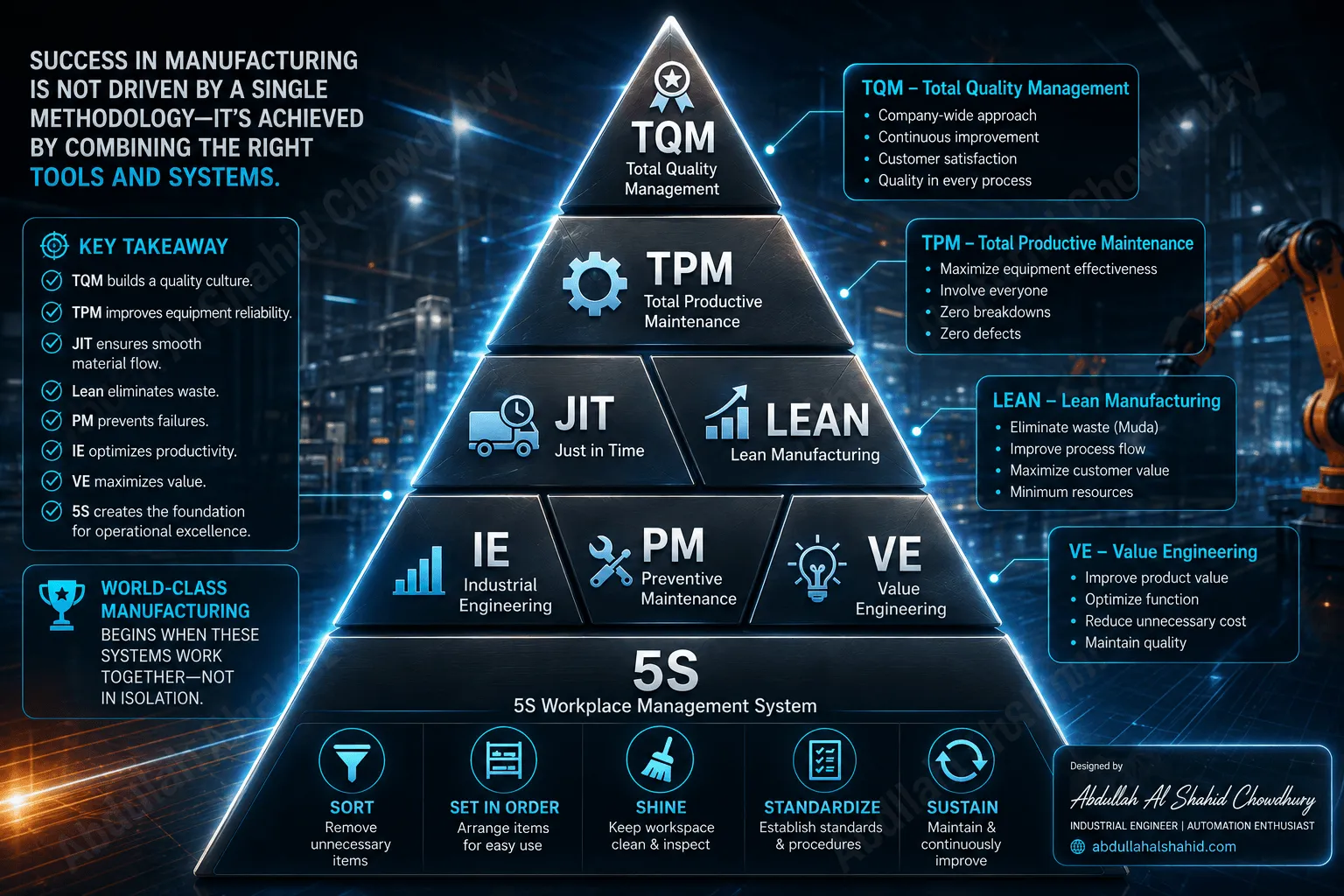
Value Engineering and 5S. Designed by Abdullah Al Shahid Chowdhury.
Manufacturing Management Systems at a Glance
Modern factories depend on multiple systems that solve different operational
problems. Total Quality Management develops a quality culture. Total
Productive Maintenance improves equipment effectiveness. Just-in-Time
supports controlled material flow. Lean Manufacturing removes waste.
Preventive Maintenance reduces avoidable failures. Industrial Engineering
optimizes resources. Value Engineering improves functional value, while
5S creates the workplace discipline required to sustain improvement.
| System | Full Name | Primary Purpose |
|---|---|---|
| TQM | Total Quality Management | Build quality and continuous improvement into every process |
| TPM | Total Productive Maintenance | Maximize equipment reliability, availability and performance |
| JIT | Just-in-Time | Produce and supply only what is needed, when it is needed |
| Lean | Lean Manufacturing | Eliminate waste and improve customer value and process flow |
| PM | Preventive Maintenance | Reduce equipment failures through planned maintenance |
| IE | Industrial Engineering | Optimize people, machines, materials, methods and time |
| VE | Value Engineering | Improve required functions while controlling unnecessary cost |
| 5S | Workplace Management System | Create an organized, visible, safe and disciplined workplace |
These methodologies are not competitors. They address different layers of
manufacturing performance and become more powerful when implemented as one
coordinated system.
1. Total Quality Management: Building Quality into the Organization
Total Quality Management, or TQM, is a company-wide approach to
continuously improving products, services, processes and customer
satisfaction.
TQM treats quality as the responsibility of the entire organization rather
than assigning it only to the quality-control department. Operators,
engineers, maintenance personnel, procurement teams, supervisors and senior
management all influence the quality of the final product.
Core principles of TQM
- Customer-focused decision-making
- Continuous process improvement
- Employee participation
- Process standardization
- Evidence-based management
- Root-cause analysis
- Supplier-quality management
- Leadership commitment
Traditional inspection attempts to identify defects after production.
TQM takes a preventive approach by improving the process that creates the
product.
Practical TQM example
Suppose a factory repeatedly identifies dimensional defects in a finished
component. A basic inspection system may separate defective products. A TQM
approach investigates the complete process, including machine settings,
operator methods, raw-material variation, measuring instruments, maintenance
conditions and training gaps.
The objective is not simply to detect more defects. The objective is to stop
the process from producing those defects.
2. Total Productive Maintenance: Improving Equipment Effectiveness
Total Productive Maintenance, or TPM, is an organization-wide
approach to improving equipment reliability, availability, performance and
employee ownership.
TPM expands maintenance beyond the traditional model in which only
technicians are responsible for machine condition. Production operators also
participate through routine cleaning, inspection, lubrication, tightening
and early detection of abnormalities.
Major TPM objectives
- Zero unexpected breakdowns
- Zero quality defects caused by equipment
- Zero avoidable accidents
- Reduced minor stoppages
- Higher equipment availability
- Improved operating speed
- Greater employee involvement
Overall Equipment Effectiveness
One of the most widely used TPM performance indicators is
Overall Equipment Effectiveness, commonly known as OEE.
OEE = Availability × Performance × Quality
A machine can appear to be running while still losing substantial production
through reduced speed, repeated minor stoppages or quality defects. OEE helps
management identify these hidden losses.
Why TPM matters
Equipment failure affects more than the maintenance budget. It can interrupt
production, increase overtime, create process variation, delay deliveries,
reduce customer confidence and force emergency purchasing.
TPM addresses these connected losses by making equipment effectiveness part
of daily production management.
3. Just-in-Time: Producing What Is Needed
Just-in-Time, or JIT, is a production and inventory-management
approach in which materials and products are supplied in the required
quantity at the required time.
The purpose of JIT is not simply to reduce inventory. Its broader objective
is to create a responsive production system with controlled flow, shorter
lead times and fewer hidden operational problems.
Problems hidden by excess inventory
- Unbalanced production lines
- Unreliable suppliers
- Long changeover times
- Weak forecasting
- Frequent quality problems
- Machine breakdowns
- Poor production planning
JIT exposes these weaknesses by reducing unnecessary buffers and forcing the
production system to become more stable.
Conditions required for effective JIT
- Reliable equipment
- Stable and standardized processes
- Consistent product quality
- Capable and responsive suppliers
- Short setup and changeover times
- Accurate production information
- Controlled internal logistics
- Effective visual-management systems
Reducing inventory without first strengthening equipment, suppliers and
processes can increase shortages and production disruptions. JIT should
therefore be introduced as part of a broader operational-improvement system.
4. Lean Manufacturing: Eliminating Waste and Improving Flow
Lean Manufacturing is a systematic approach to maximizing customer
value while minimizing activities that consume resources without adding
value.
Lean management asks a fundamental question:
Does this activity create value from the customer’s perspective?
Any activity that consumes time, labour, energy, space or materials without
contributing to the required product or service may represent waste.
The eight wastes of Lean Manufacturing
- Transportation: unnecessary movement of materials or products
- Inventory: excess raw materials, work in progress or finished goods
- Motion: unnecessary movement by people or equipment
- Waiting: idle time between production activities
- Overproduction: producing earlier or in greater quantity than required
- Overprocessing: performing more work than the customer requires
- Defects: scrap, rework, repair and correction
- Unused talent: failing to use employees’ knowledge and capabilities
Common Lean tools
- Value-stream mapping
- Kaizen
- Standardized work
- Visual management
- Kanban
- Cellular manufacturing
- Takt-time analysis
- Error-proofing or Poka-Yoke
- Single-Minute Exchange of Die
- Root-cause analysis
Lean Manufacturing should not be treated as a headcount-reduction program.
Its purpose is to improve value, quality, flow, safety and problem-solving
capability across the production system.
5. Preventive Maintenance: Preventing Failures Before They Occur
Preventive Maintenance, or PM, is planned maintenance performed at
predetermined intervals to reduce the probability of equipment failure.
Preventive activities may be scheduled according to:
- Calendar time
- Machine operating hours
- Production cycles
- Manufacturer recommendations
- Equipment history
- Risk and criticality
- Statutory inspection requirements
Typical preventive-maintenance activities
- Cleaning and lubrication
- Tightening electrical and mechanical connections
- Alignment and balancing
- Calibration of instruments
- Replacement of filters and wear components
- Insulation-resistance testing
- Temperature and vibration checks
- Safety-device inspection
Preventive versus reactive maintenance
Reactive maintenance begins after equipment has already failed. It may be
acceptable for low-cost and non-critical assets, but excessive dependence on
breakdown maintenance creates unstable production and unpredictable cost.
Preventive Maintenance allows work to be planned before a functional failure
interrupts production. However, maintenance intervals should reflect asset
criticality, operating conditions, failure history and actual risk.
6. Industrial Engineering: Optimizing the Complete Production System
Industrial Engineering improves productivity by optimizing the
interaction between people, machines, materials, methods, information,
energy and time.
Industrial engineers analyze the complete work system rather than focusing
only on a single machine or department.
Common Industrial Engineering activities
- Time study and work measurement
- Method study
- Production-line balancing
- Capacity planning
- Facility-layout optimization
- Ergonomic assessment
- Bottleneck analysis
- Material-handling improvement
- Workforce planning
- Productivity measurement
- Operations research
- Production simulation
Industrial Engineering example
A production line may have sufficient total labour and machine capacity but
still fail to meet its output target because work is distributed unevenly.
Industrial Engineering can identify the cycle time of each operation,
compare it with takt time, locate the bottleneck and rebalance tasks across
workstations. The result may be higher output without purchasing an
additional machine.
7. Value Engineering: Improving Function at the Right Cost
Value Engineering, or VE, is a structured method for improving the
relationship between a product’s required function and its total cost.
Value = Required Function ÷ Cost
Value can be improved by:
- Achieving the required function at a lower lifecycle cost
- Improving function without a disproportionate cost increase
- Removing features that do not support the required function
- Selecting more suitable materials
- Simplifying design and assembly
- Improving maintainability
- Reducing energy consumption
- Improving reliability and service life
Value Engineering does not mean selecting the cheapest component. A
lower-priced part that causes frequent failures, unsafe operation or high
maintenance costs may reduce total value.
The objective is to preserve or improve the necessary function while
eliminating cost that does not contribute to performance, quality,
reliability or customer value.
8. 5S: The Foundation of Workplace Discipline
5S is a workplace-management system that creates an organized,
visible, clean, safe and repeatable operating environment.
Sort
Remove tools, materials, documents and items that are not required for
current operations.
Set in Order
Arrange necessary items so that they can be located, used and returned
efficiently.
Shine
Clean the workplace while inspecting machines, tools and surrounding areas
for abnormalities.
Standardize
Create visual controls, procedures, checklists and responsibilities that
maintain the first three stages.
Sustain
Develop the routines, leadership behaviour, audits and employee discipline
required to prevent the workplace from returning to its previous condition.
Benefits of an effective 5S system
- Faster detection of abnormalities
- Safer employee movement
- Reduced searching and handling time
- Improved material control
- Easier equipment inspection
- Better visual management
- Stronger workplace ownership
- Improved quality and productivity
5S should not be treated as a one-time cleaning campaign. Its real value
comes from maintaining workplace discipline every day.
How These Manufacturing Systems Work Together
Each methodology supports a different layer of operational performance.
The strongest results appear when they are implemented as parts of one
connected system.
5S creates workplace stability
A clean and organized workplace makes leaks, damage, misplaced materials,
loose components, unsafe conditions and process abnormalities easier to see.
Preventive Maintenance protects basic equipment condition
Planned maintenance reduces predictable deterioration and supports stable
production.
Industrial Engineering improves resource utilization
Industrial Engineering analyzes work methods, layouts, labour, capacity,
material movement and cycle time.
Value Engineering improves functional value
Value Engineering challenges unnecessary cost while protecting the required
function, safety, reliability and quality.
Lean improves production flow
Lean eliminates non-value-adding activities, excessive movement, delay,
overproduction, inventory and defects.
Just-in-Time synchronizes material and production flow
JIT aligns production and replenishment with actual customer and process
requirements.
TPM develops equipment ownership
TPM brings production, maintenance and engineering teams together to remove
equipment-related losses.
TQM integrates quality across the enterprise
TQM connects customer expectations, leadership, employee participation,
process control and continuous improvement.
Key Takeaway
World-class manufacturing begins when quality, maintenance, production,
engineering, supply chain and workplace systems operate together—not in
isolation.
A Practical Manufacturing-Improvement Roadmap
Organizations often lose momentum because they attempt to launch too many
improvement programs simultaneously. A phased implementation sequence is
easier to control and sustain.
Phase 1: Stabilize the workplace
- Implement 5S
- Strengthen safety controls
- Introduce visual management
- Develop basic work standards
- Clean and inspect equipment
Phase 2: Stabilize equipment
- Create a Preventive Maintenance schedule
- Classify assets according to criticality
- Record equipment failures
- Improve spare-parts control
- Track maintenance indicators
Phase 3: Stabilize quality
- Create standard operating procedures
- Define inspection criteria
- Use root-cause analysis
- Strengthen process controls
- Train operators and supervisors
- Implement corrective and preventive actions
Phase 4: Improve productivity and flow
- Conduct time and motion studies
- Balance production lines
- Identify bottlenecks
- Improve factory layout
- Create value-stream maps
- Reduce setup and changeover time
- Introduce pull and Kanban systems where appropriate
Phase 5: Optimize lifecycle value
- Apply Value Engineering
- Calculate lifecycle cost
- Improve product and equipment reliability
- Simplify design and assembly
- Reduce energy and utility losses
- Launch cross-functional improvement projects
Phase 6: Integrate the management system
Connect quality, maintenance, production, engineering and supply-chain
objectives through shared responsibilities, performance indicators and
management-review processes.
Manufacturing KPIs to Track
Manufacturing improvement should be supported by a focused set of indicators
that help employees and managers make decisions.
| Performance Area | Recommended KPI | Purpose |
|---|---|---|
| Quality | First-Pass Yield | Measures products completed correctly without rework |
| Quality | Defect Rate | Measures defective production as a proportion of total output |
| Quality | Cost of Poor Quality | Tracks scrap, rework, complaints and failure-related cost |
| Maintenance | Mean Time Between Failures | Measures average operating time between equipment failures |
| Maintenance | Mean Time to Repair | Measures average time required to restore equipment |
| Equipment | Overall Equipment Effectiveness | Measures availability, performance and quality losses |
| Production | Cycle Time | Measures the time required to complete a production cycle |
| Production | Schedule Attainment | Compares actual production with planned production |
| Delivery | On-Time Delivery | Measures orders delivered according to commitment |
| Inventory | Inventory Turnover | Measures how efficiently inventory is used |
| Lean | Manufacturing Lead Time | Measures total time from production release to completion |
| Productivity | Output per Labour Hour | Measures workforce productivity |
| Cost | Manufacturing Cost per Unit | Tracks the cost required to produce each unit |
| Safety | Lost-Time Incident Rate | Measures serious work-related safety incidents |
A KPI should support decisions and corrective action. Collecting large
volumes of data without ownership or follow-up creates reporting activity
rather than operational improvement.
Common Manufacturing-System Implementation Mistakes
Treating 5S as a cleaning event
A workplace may look organized immediately before an audit while lacking
daily standards, ownership and discipline.
Reducing inventory before improving reliability
JIT exposes operational problems, but uncontrolled inventory reduction can
create severe shortages when equipment and suppliers remain unstable.
Making maintenance solely responsible for TPM
TPM requires coordinated participation from production, maintenance,
engineering and management.
Using Lean only to reduce headcount
This creates resistance and ignores Lean Manufacturing’s real purpose:
improving flow, quality, safety, customer value and problem-solving.
Tracking too many KPIs
A complicated dashboard can hide the few indicators that genuinely influence
customer, production and financial performance.
Copying another factory’s system
The correct manufacturing method depends on product type, demand pattern,
equipment condition, workforce capability, factory maturity and business
risk.
Launching programs without management follow-through
Improvement systems decline when leaders treat them as slogans rather than
daily operating practices.
Final Perspective
World-class manufacturing is not built through a single tool or department.
- TQM creates a culture of quality.
- TPM improves equipment ownership and effectiveness.
- JIT synchronizes production with actual requirements.
- Lean eliminates waste and improves flow.
- Preventive Maintenance reduces avoidable failures.
- Industrial Engineering optimizes the production system.
- Value Engineering improves function and lifecycle value.
- 5S creates the discipline required to sustain excellence.
The most successful manufacturing organizations do not ask which one of
these systems they should choose. They determine how each system can support
the others within one coherent operating model.
Frequently Asked Questions
What is the difference between TQM and TPM?
TQM focuses on organization-wide quality, customer satisfaction and
continuous improvement. TPM focuses on equipment effectiveness,
reliability and employee involvement in maintenance. TPM supports TQM
because reliable machines are essential for consistent product quality.
Is 5S part of Lean Manufacturing?
5S is commonly used as a foundational Lean practice. It creates an
organized and visible workplace where waste, unsafe conditions and process
abnormalities are easier to identify.
What is the difference between TPM and Preventive Maintenance?
Preventive Maintenance consists of scheduled activities intended to reduce
equipment failure. TPM is a broader management system that includes
Preventive Maintenance, operator participation, equipment-loss reduction,
quality maintenance, training and continuous improvement.
Can Just-in-Time work without Lean Manufacturing?
JIT can be introduced independently, but it is difficult to sustain without
reliable equipment, consistent quality, short lead times, stable suppliers
and effective problem-solving. Lean practices help create those conditions.
Which manufacturing system should a factory implement first?
Many factories benefit from starting with 5S, safety, standardized work
and basic Preventive Maintenance. The exact starting point should be based
on the factory’s most serious operational risks and constraints.
How does Industrial Engineering support Lean Manufacturing?
Industrial Engineering provides analytical methods for measuring work,
balancing production, planning capacity, improving layouts and reducing
unnecessary movement. These methods help Lean teams identify and remove
operational waste.
Does Value Engineering reduce product quality?
Proper Value Engineering does not reduce required quality. It removes
unnecessary cost while protecting or improving function, performance,
reliability, safety and maintainability.
What is the most important factor in manufacturing improvement?
Consistent management follow-through is usually more important than the
number of tools introduced. Clear standards, employee participation,
accurate measurement and sustained corrective action determine whether an
improvement system succeeds.